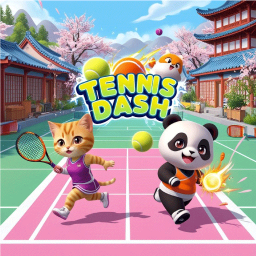
Game Objective
The goal of Tennis Dash is simple: return every shot your opponent sends your way and score more points than them. Each rally is a test of reflexes and placement. Win enough rallies to take the set, and win enough sets to climb the leaderboard and face tougher opponents.
Matches start gently, giving you time to adjust to the pace. As you improve, the AI opponent adapts, using sharper angles and faster serves to challenge your growing skills.
Controls
Tennis Dash uses intuitive drag-based controls that work beautifully on both desktop and mobile devices.
Desktop — Mouse
Move your mouse across the court to position the racket. The racket follows your cursor in real time. Click is not required — simply hover and the racket tracks your movement.
Mobile — Touch
Touch and drag anywhere on the screen to move your racket. The response is instant, so even rapid changes in direction feel natural and precise.
Shot Direction
The position of your racket when the ball makes contact determines the angle of your return. Hitting with the edge sends the ball wide; hitting centre keeps it straight.
Shot Power
Moving your racket into the ball adds power. A stationary racket produces a softer, more controlled shot. Master the balance between speed and placement.
Game Mechanics
Scoring System
Tennis Dash follows a simplified tennis scoring structure. Each rally awards a point to the winner. Accumulate enough points to win a set, and win enough sets to complete the match. The exact thresholds increase as you advance through the ranks.
Ball Physics
The ball in Tennis Dash obeys realistic bounce physics. It accelerates on hard hits, decelerates on soft touches, and curves based on the angle of contact with your racket. Understanding these physics is key to placing your shots precisely where your opponent cannot reach.
AI Opponent Behaviour
The game features a dynamic AI system that adjusts to your skill level. In early matches, the opponent moves slowly and favours predictable patterns. As you climb the leaderboard, the AI begins to:
- Serve with increased speed and varied placement
- Use cross-court angles to exploit open areas
- Attempt drop shots when you are positioned deep
- Recover faster after each shot, reducing your time advantage
💡 Pro Tip
Watch the opponent's position before they hit the ball. If they are close to the net, aim your return deep toward the baseline. If they are far back, a short angle shot can catch them off guard.
Tips for Beginners
- Stay centred: After each return, quickly move your racket back to the middle of the court. This gives you the best chance to reach the next shot.
- Focus on returning first: Do not worry about winning points with power shots early on. Consistency wins matches — just keep the ball in play.
- Read the bounce: Pay attention to where the ball lands on your side. The bounce angle tells you exactly where to position your racket.
- Use the edges: Returning the ball to the corners of the opponent's court forces them to cover more ground and opens up space for your next shot.
- Stay calm under pressure: When facing a fast serve, resist the urge to swipe wildly. A smooth, controlled drag is more effective than a frantic one.
Advanced Techniques
The Angle Game
Once you are comfortable returning shots consistently, start focusing on angles. By positioning your racket slightly off-centre when the ball arrives, you can send sharp cross-court returns that are extremely difficult for the AI to reach. This is the single most effective technique for beating higher-ranked opponents.
Speed Variation
Alternating between hard drives and soft placements keeps the AI guessing. A powerful shot followed by a gentle drop forces the opponent into constant acceleration and deceleration, eventually creating an opening.
Baseline Control
Keeping the ball deep — consistently landing your returns near the opponent's baseline — limits their options. From deep in the court, the AI has to hit with less angle, giving you easier returns. This is especially effective in later stages when opponents become more aggressive at the net.
🎯 Advanced Tip
Practice the "one-two punch" — send a deep shot to one corner, then immediately follow up with a sharp angle to the opposite corner. This combination wins points at every skill level.
Frequently Asked Questions
Why does the ball sometimes go out of bounds?
If you hit the ball with the very edge of your racket while moving quickly, the return angle can exceed the court boundaries. Focus on meeting the ball closer to the centre of your racket for more controlled shots.
How do I beat the harder opponents?
Patience is key. Do not try to end rallies quickly against tough AI. Instead, focus on consistent deep returns and wait for the opponent to make a mistake or leave an opening. Use angle shots and speed variation to create those openings.
Is there a way to practise without playing a match?
The early stages of Tennis Dash serve as an excellent practice ground. The opponents are forgiving enough that you can experiment with different techniques without worrying about losing.